

Need custom software for your business?
Table of Contents
Native vs Hybrid App: Which One is Best for USA-Based Businesses?

Oct 23, 2026· 9 min read
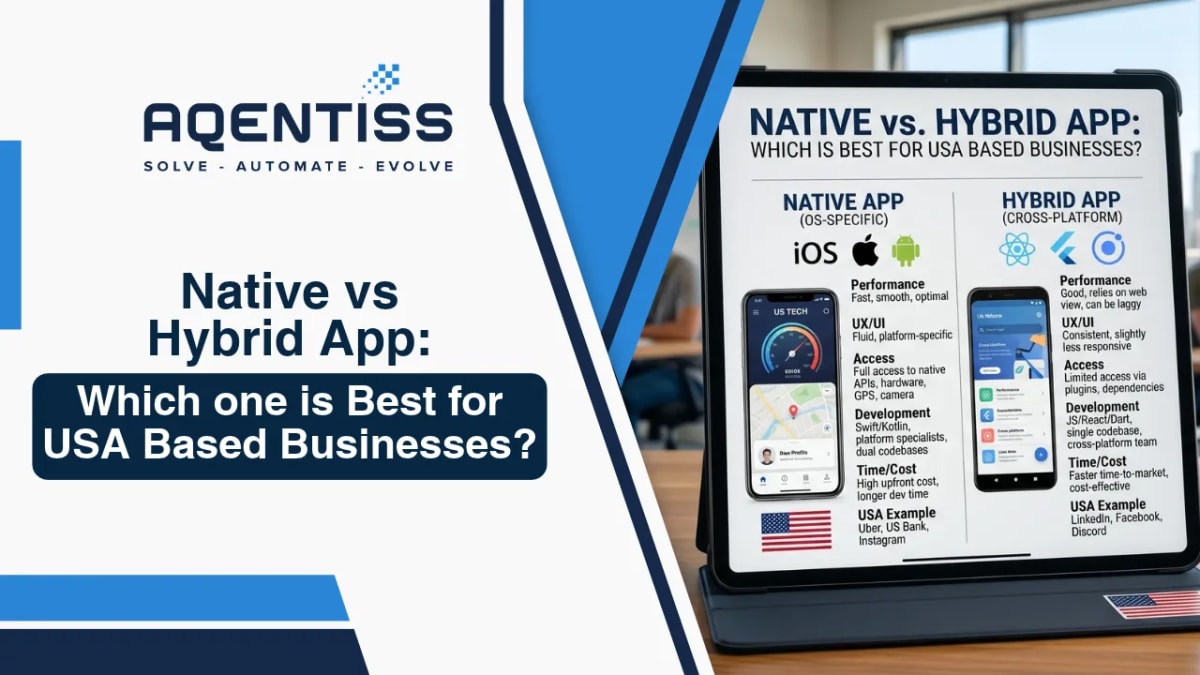
When planning to build a mobile app, one of the first decisions businesses face is choosing between native and hybrid app development. This choice can impact your app’s performance, cost, user experience, and long-term scalability. Understanding the difference between native vs hybrid apps helps you make a smarter decision based on your business goals.
For USA-based businesses, where user expectations are high and competition is strong, selecting the right approach can directly affect success. In this guide, we break down everything you need to know about native vs hybrid mobile apps in a simple and practical way.
Key Takeaways
Understanding native vs hybrid apps helps businesses make better development decisions.
Native apps offer higher performance, better security, and a smoother user experience.
Hybrid apps are more cost-effective and faster to develop using a single codebase.
The difference between native and hybrid apps mainly lies in performance, cost, and development time.
Native apps are better suited for complex, high-performance applications.
Hybrid apps work well for startups and businesses looking for faster market entry.
Technologies like Swift and Kotlin are used for native apps, while Flutter and React Native are used for hybrid apps.
Cost plays a major role, with hybrid apps generally being more budget-friendly.
The right choice depends on your business goals, app complexity, and long-term scalability needs.
What is a Native Mobile App?
A native application is built specifically for a single platform, either iOS or Android, using platform-specific programming languages. For example, Swift is used for iOS, and Kotlin or Java is used for Android.
Native mobile application development focuses on delivering high performance and a smooth user experience by fully utilizing the device’s capabilities.
What are the Key Features of Native Apps
Native apps are designed to deliver a smooth and high-quality experience by fully utilizing the capabilities of a specific platform.
Built for a specific platform (iOS or Android)
High performance and fast response time
Better access to device features like camera, GPS, and sensors
Strong security and reliability
Smooth and responsive user interface
Advantages and Disadvantages of Native Apps
Before deciding on native app development, it is important to understand both its strengths and the trade-offs involved.
Advantages of Native Apps
Excellent performance and speed
Better user experience
Strong security features
Easy integration with device hardware
Ideal for complex and high-traffic applications
Disadvantages of Native Apps
Higher app development cost
Separate codebase for iOS and Android
Longer development time
Maintenance can require more effort
Examples of Native Apps
Some well-known native apps include:
Instagram
Spotify
Google Maps
WhatsApp
Uber
These apps rely on performance and user experience, which is why they use native app development services.
What is a Hybrid App?
A hybrid app is a type of mobile application that works across both iOS and Android using a single codebase. It is built using web technologies like HTML, CSS, and JavaScript, combined with frameworks such as Flutter or React Native. A hybrid mobile application allows businesses to launch apps faster while reducing development effort.
What are the Key Features of Hybrid Apps
Hybrid apps are built to give businesses a faster and more flexible way to launch across multiple platforms.
Single codebase for multiple platforms
Faster development process
Cost-effective compared to native apps
Easier maintenance and updates
Works across devices with a consistent design
Advantages and Disadvantages of Hybrid Apps
Like any development approach, hybrid apps come with clear benefits as well as a few limitations to consider.
Advantages of Hybrid Apps
Lower development cost
Faster time to market
Easier to maintain and update
Ideal for startups and SMEs
Good option for simpler applications
Disadvantages of Hybrid Apps
Performance may be slightly lower than native apps
Limited access to some device features
May require optimization for complex apps
User experience may not be as smooth as native
Examples of Hybrid Applications
Some popular hybrid apps include:
Uber Eats
Airbnb (partially hybrid approach)
Gmail (web-based hybrid elements)
Twitter(x)
Evernote
These apps show how hybrid apps development can support large-scale platforms when built properly.
Native vs Hybrid Apps: Key Differences & Comparison

Native and hybrid mobile apps visual comparison on smartphones
A side-by-side comparison makes it easier to understand how native and hybrid apps differ in terms of cost, speed, user experience, and long-term business value.
Feature | Native Apps | Hybrid Apps |
Performance | High | Moderate to High |
Development Cost | Higher | Lower |
Development Time | Longer | Faster |
Codebase | Separate for each platform | Single codebase |
User Experience | Excellent | Good |
Maintenance | More effort | Easier |
Scalability | High | Moderate to High |
The difference between native and hybrid app mainly comes down to performance, cost, and development speed.
What are the Common Technologies Used for Hybrid & Native App Development?
The choice of technologies plays a key role in how efficiently native and hybrid apps are built and how well they perform in real-world use.
Native Technologies:
Swift (iOS)
Kotlin / Java (Android)
Hybrid Technologies:
Flutter
React Native
HTML, CSS, JavaScript
These technologies define how native vs hybrid mobile app development is approached in real-world projects.
How Native and Hybrid Apps Align with Business Objectives?
The right choice depends on your business needs. Native apps are better suited for businesses that need high performance, advanced features, and a premium user experience. This is common in industries like fintech, gaming, and large-scale platforms.
Hybrid apps are ideal for businesses that want to launch quickly, manage costs, and reach both iOS and Android users at the same time. This works well for startups, SMEs, and service-based apps. Understanding your goals helps you decide between native and hybrid applications more effectively.
You May Also Read: iOS vs Android App Development: Which App Platform Is Better in 2026?
Cost Comparison: Native vs Hybrid App Development
Cost plays a big role when deciding between hybrid app development vs native.
Native app development cost is usually higher because separate apps are built for each platform. In the USA, a basic native app can start from $25,000 to $50,000 per platform, while more complex apps can go beyond $100,000+
Hybrid app development cost is lower due to a single codebase. A basic hybrid app may range from $20,000 to $40,000, while more advanced apps can go up to $70,000+
Hybrid apps also help reduce long-term maintenance costs since updates are managed in one place
For many USA-based businesses, the decision often comes down to balancing budget with performance and long-term goals.
Which is Better: Native or Hybrid App?

Users testing mobile application on smartphone and tablet
There is no single answer. The better option depends on your project.
Choose native apps if you need:
High performance
Complex features
Strong security
Best-in-class user experience
Choose hybrid apps if you need:
Faster development
Lower cost
Cross-platform reach
Simpler functionality
In the end, the decision between native vs hybrid apps should be based on your business goals, budget, and long-term plans. A well-planned approach, backed by the right development team, will always deliver better results regardless of the technology you choose.
Conclusion
Both native and hybrid apps have their strengths, and the right choice depends on what your business needs most. By understanding the trade-offs in performance, cost, and scalability, USA-based businesses can make a more informed decision and build an app that supports long-term growth.
FAQs
Is native app development better than hybrid?
Native app development is better for performance, speed, and user experience, especially for complex apps. Hybrid apps are better for faster development and lower cost. The right option depends on your business needs.
Which is more cost-effective: native or hybrid apps?
Hybrid apps are usually more cost-effective because they use a single codebase for both iOS and Android. Native apps require separate development for each platform, which increases cost.
Can I build a mobile app with React Native?
Yes, React Native is a popular framework used to build hybrid apps. It allows you to create apps for both iOS and Android using one codebase, making development faster and more efficient.
What tech stacks are used for hybrid & native app development?
Native apps use Swift for iOS and Kotlin or Java for Android. Hybrid apps use technologies like Flutter, React Native, along with HTML, CSS, and JavaScript.
Which is better for scalability: Native or Hybrid?
Native apps are generally better for high scalability and performance-heavy applications. However, modern hybrid frameworks like Flutter and React Native can also handle scalable apps if built properly.
Which app is better for complex features: Native or Hybrid?
Native apps are better for complex features, especially those that rely heavily on device hardware or advanced performance, such as gaming or real-time processing.
Will choosing a hybrid app affect performance in the long run?
For simple to moderately complex apps, hybrid performance is usually sufficient. However, for very complex or high-performance apps, native development may offer better long-term performance.
What are the key considerations for choosing between a native and a hybrid app?
You should consider your budget, timeline, app complexity, target audience, and long-term goals. If performance and advanced features are a priority, native is a better choice. If speed and cost matter more, hybrid is a practical option.
Tejas Golwala is an author and contributor at Aqentiss, covering software engineering, architecture, and technology innovations.
Ready to Get Started?
Let's Build Your Custom Software
Talk to our team about your project. Get a free consultation and a clear cost estimate.